Flash Sale 70% Off
Give customers details about the banner image(s) or content on the template.
Eczema Diet

An eczema diet for kids can feel impossibly confusing when your child is still itchy, bleeding, or waking all night no matter what you try.
You pull dairy, then gluten, then eggs, you buy the “eczema-safe” snacks, you spend money on tests… and your kid is still scratching. It’s maddening.
In this article, I’m sharing a practical, food-as-medicine roadmap inspired by a powerful conversation with registered dietitian and functional medicine practitioner Ali Miller, RD, author of Naturally Nourished Kids. We’re going to zoom out from trendy elimination lists and get back to the foundations that actually move the needle: whole real food, blood sugar balance, gut integrity, and realistic meals your kids will actually eat.
We’ll cover:
Take a breath. This is fixable. Let’s go step by step.
A hard truth: most families are doing food backwards.
Ali sees it in her practice and I see it with Eczema Kids parents all the time:
But their child still isn’t eating a whole-food diet.
If a child is living on ultra-processed snacks, gluten-free waffles, and plant-based “dairy-free” junk, there is no test in the world that can save that situation. The foundation has to be:
Only then does testing give you useful, not just overwhelming, data.
Ali often won’t test until a family has a solid three months of whole real food under their belt. I do something similar with my students: once we pull obvious inflammatory foods and the child’s gut has started to calm down, a huge percentage of kids never even need advanced labs. Their skin just… clears as the gut heals.
“Your child will absolutely rise to the level of responsibility and understanding you offer them. When you treat them like a partner in healing instead of a problem to manage, everything changes.” -Andra McHugh
Leaky gut is more than a buzzword. It’s literally damage at the level of the tiny “tight junctions” in the intestinal lining. Those cells should be hugging each other; instead, they’re gapped and irritated.
What that means in real life for your child:
On the outside, that looks like:
And it’s not just skin. Because the gut is wired to the brain through the enteric nervous system, leaky gut frequently shows up as:
You’re not imagining it: when your child’s gut is inflamed and imbalanced, they really are more reactive, more anxious, and harder to regulate. The gut infection itself literally pushes out more adrenaline and less serotonin and GABA. They don’t just “grow out of it” if we ignore the root cause.
One of the most overlooked early warnings of gut imbalance is cradle cap and baby skin issues.
We’re told “it’s normal,” just put some ointment on it and move on. But cradle cap is often fungal in nature and a clue that baby’s microbiome and gut lining need support.
If you’re seeing:
Then before you rush to introduce solid foods at 6 months “because the calendar says so,” consider:
If the gut lining is not ready and we start throwing in solids, especially harder-to-digest foods, we can unintentionally set the stage for more food sensitivities and more intense eczema later.
Here’s where a lot of eczema parents get burned: they hear “gut health” and then load up on bone broth, sauerkraut, and fermented foods.
Then the itch gets worse.
Histamine intolerance is basically your child’s body saying, “I cannot clear this much histamine right now because my gut and detox systems are overwhelmed.”
Signs histamine may be part of the picture:
The tricky part:
So instead of a long-term low-histamine diet (which often starves the child of needed nutrients), the focus should be:
If a child truly can’t tolerate bone broth or meats without flaring, that’s when Ali recommends investing in a good stool panel. Not to guess, but to actually see which pathogens are present and choose specific herbal antimicrobials instead of throwing random powders at the problem.
Students inside the Eczema Elimination Method can access advanced tests like the GI-MAP at cost, and I’ll personally walk you through the results and build a brand-new, customized plan for your child (or for you).
Most kids with eczema are wildly under-eating protein.
Protein is not optional. It’s the literal building block for:
Ali’s general guideline for growing kids:
This is dramatically higher than conventional recommendations, and that’s honestly why so many kids are struggling. They’re drowning in carbs, missing protein, and living in a constant blood sugar roller coaster.
A simple way to think about it:
Everything else (carbs, fruit, starch) is built around that, not the other way around
Everything marketed to kids is basically a carb. Cereal, puffs, bars, crackers, “yogurt” tubes, pouches, granola bars, “healthy” cookies – even the organic, gluten-free, dairy-free versions are mostly just sugar.
What goes up must come down.
That crash is what drives the constant snacking culture in schools and daycares. If breakfast is cereal, milk, fruit, and maybe toast, the kid is guaranteed to need a snack an hour or two later just to function.
Stabilizing blood sugar (and therefore mood, attention, and itch) means:
You’ll be shocked at how quickly behavior improves once blood sugar steadies – we’re talking days, not months.
Here’s an uncomfortable reality: most kids snack way too much.
That constant grazing:
If you have a picky eater who refuses dinner, step one is almost always: pull back the snacks.
Some guidelines:
One practical strategy Ali uses with her daughter:
Is this culturally normal? No. Is it what works for healing and sanity? Yep.
Kids are not just picky; they’re powerful. Food is one of the easiest places for them to flex control.
If they see that you get flustered, beg, bargain, and become a short-order cook when they refuse something, they just learned that food is a lever they can pull.
The antidote is a combo of compassion and clarity:
Leftover dinner can become breakfast and lunch until it’s eaten.
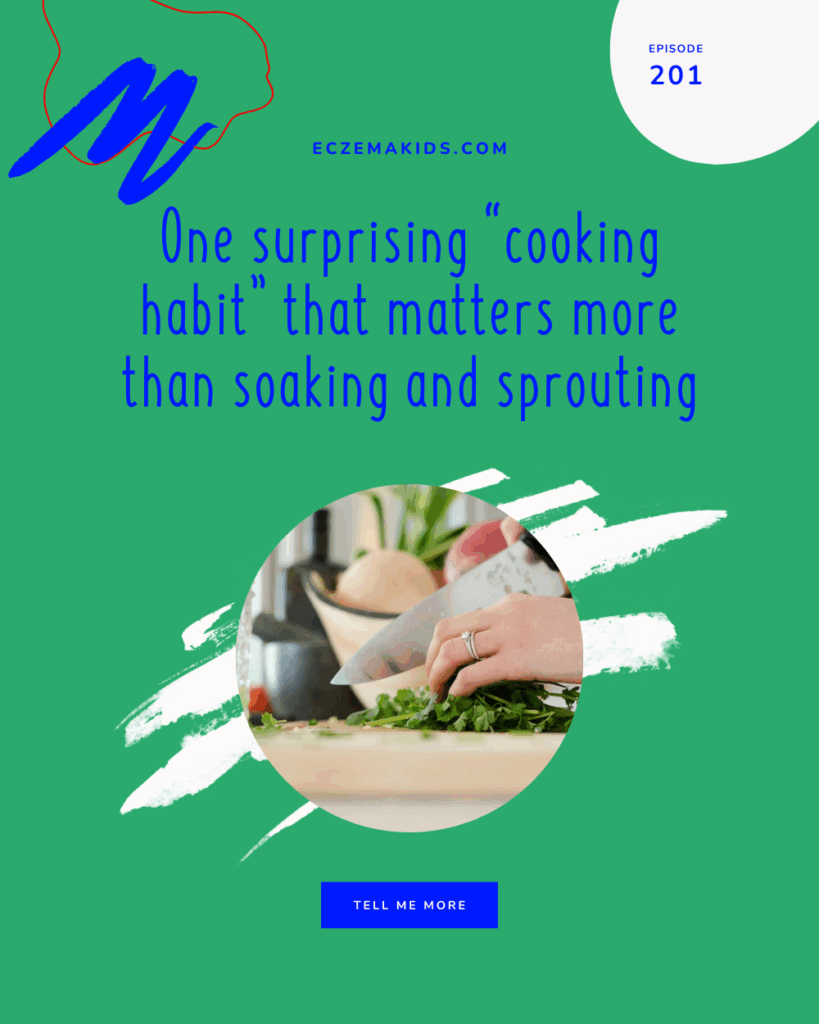
Soaking grains, sprouting, fermenting – all of that can help reduce anti-nutrients and support digestion.
But one habit matters even more: getting your child into a parasympathetic, “rest-and-digest” state before eating.
When a child is:
Their body is in fight-or-flight. In that state:
Simple practices to support digestion:
For kids with compromised gut health, you can also use:
Again, the theme: give their body every possible advantage to actually use the nourishing food you’re working so hard to provide.
You don’t need to renovate everything overnight. Here are three needle-movers you can implement right away:
You’ll start to see shifts in energy, mood, and skin far faster than you think. Kids are incredibly resilient when we finally give their bodies what they need.
Look into Eczema Safe Snacks, Eczema-Friendly Meals and Eczema Food Triggers

How fast can an eczema-friendly diet help my child’s skin?
Every child is different, but when you dial in whole foods, pull obvious inflammatory triggers, and stabilize blood sugar, you can often see early changes in a matter of days. It might start with better sleep, fewer meltdowns, or less intense redness. Within a couple of weeks, many parents notice softer patches, fewer open areas, and easier mornings and evenings. Deeper gut healing takes longer, but fast wins are very common in kids because their systems are so responsive.
Does my child need expensive food sensitivity and stool testing to heal?
Not necessarily. For a lot of kids, you can make enormous progress by focusing on food quality (whole real foods), protein intake, blood sugar balance, and basic gut support. Testing becomes more important when you have: extreme reactions, no improvement after several months of consistent work, or clear signs of histamine or severe dysbiosis where they can’t tolerate typical healing foods like meats or broths. Think of testing as a second step once the foundations are solid, not the first move. If you’re considering testing, try our natural eczema reversal program, The Eczema Elimination Method.


Helping kids find calmer skin and helping parents find a clearer path forward.
Helping kids find calmer skin and helping parents find a clearer path forward.